

Features
Maldives-Türkiye Trade Agreement Enters Into Force, Covering 558 Tariff Lines
The Maldives-Türkiye Preferential Trade Agreement, signed in Istanbul in November 2024, entered into force on August 1, 2026, after Türkiye's parliament ratified it in late 2025
Sham'aan Shakir
01 August 2026, 13:10
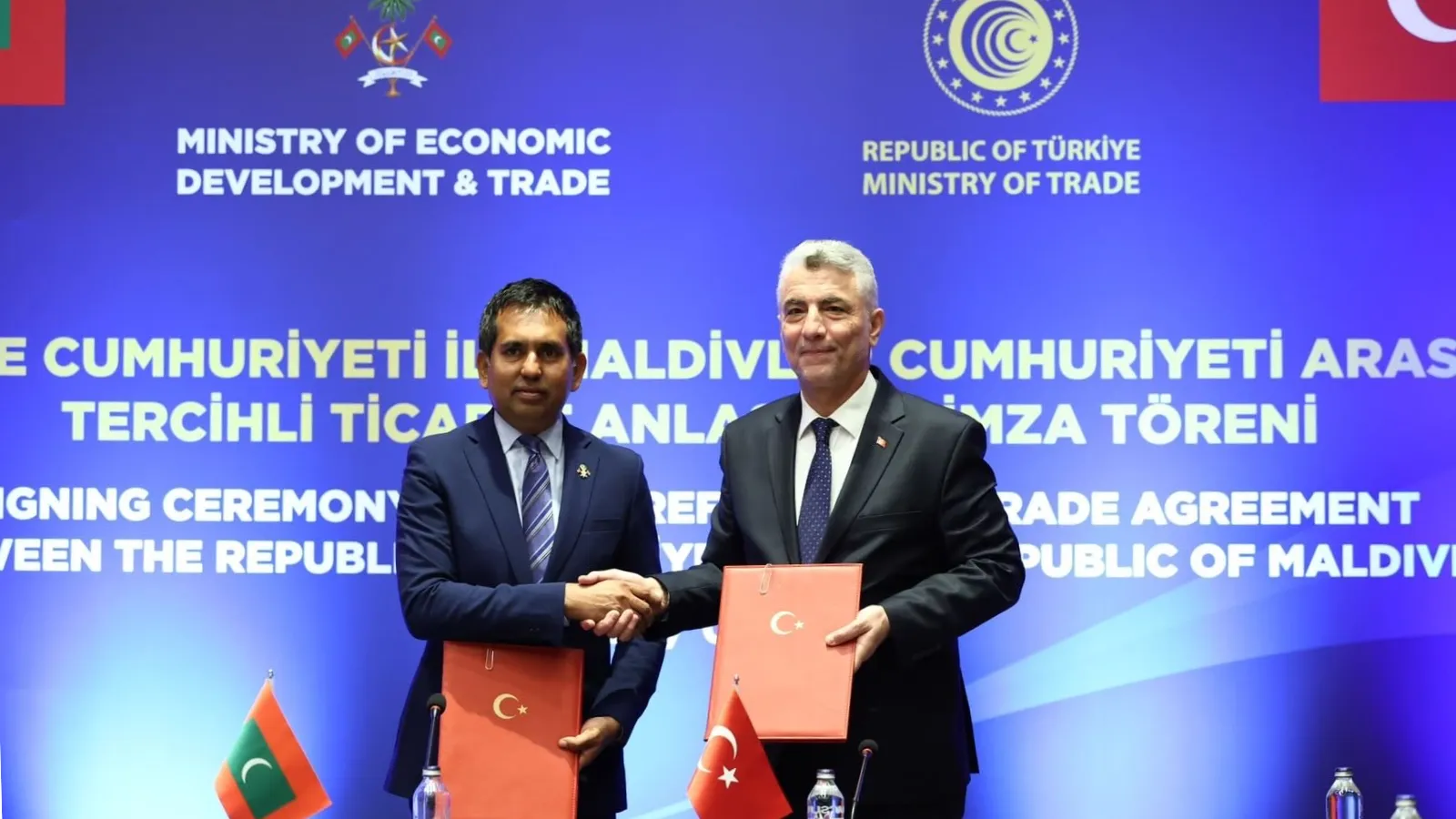
The Preferential Trade Agreement (PTA) between the Maldives and Türkiye took effect on August 1, 2026. The deal cuts or removes import duties on goods worth hundreds of product categories traded between the two countries.
The Ministry of Economic Development, Transport and Trade confirmed the agreement's entry into force in a government gazette notice issued the same day. The notice said Male' and Ankara had exchanged final written notifications confirming both countries had completed the domestic legal steps required under Article 25 of the Agreement.
The two governments signed the PTA in Istanbul on November 4, 2024. Then Maldives Minister of Economic Development and Trade Mohamed Saeed signed on behalf of Male'. Turkish Trade Minister Prof. Dr. Ömer Bolat signed for Ankara. The deal took nearly 21 months to take effect. The Turkish parliament approved it in October 2025, and Türkiye published its ratification decision in its Official Gazette on December 19, 2025, according to Hürriyet Daily News.
Saeed has since been sworn in as Minister of Economic Development, Transport and Trade following a cabinet restructuring in April 2026. He kept the trade portfolio.
What the Agreement Covers
The PTA reduces tariffs on trade in goods between the two countries. It also sets rules for determining where a product originates, which goods qualify for lower duties, and how customs authorities on both sides verify and cooperate on those claims.
The agreement does not cover services, investment, or government procurement. It focuses only on goods trade and related customs matters.
By The Numbers
Maldives Business Review reviewed the agreement's tariff annexes directly. Türkiye's schedule lists 154 tariff lines from the Maldives that receive preferential treatment, nearly all of them fish and seafood products such as mackerel, shrimp, cuttlefish, swordfish, and fish meal. Of these, 94 lines carry an actual cut in duty. The remaining 60 were already duty free under Türkiye's normal trade rules, so the agreement simply locks in that existing access rather than creating new savings.
The Maldives' schedule lists 404 tariff lines from Türkiye. Of these, 293 lines see the Maldives eliminate duties entirely, cutting rates that ranged from 15 percent to 50 percent down to zero. The other 111 lines were already at zero percent and are simply reaffirmed under the deal. The products affected span iron and steel building materials, aluminium goods, electrical appliances, refrigerators, air conditioners, televisions, vessels, furniture, plastics, cosmetics, and selected food items.
Combined, the agreement covers 558 tariff lines across both countries. This figure, drawn directly from the treaty's own annexes, is corroborated by Hürriyet Daily News, which reported the same 404, 293, 111, and 154 figures citing Türkiye's Trade Ministry.
A statement shared by the Ministry attributed to Minister Saeed described the deal as exchanging "preferential tariff concessions across 75 tariff lines." That figure is well below the totals recorded in the agreement's own schedules. The basis for the smaller number could not be confirmed from available material.
A Closer Look at the Tuna Quota
Canned and prepared tuna, one of the Maldives' most valuable seafood exports, falls under Harmonized System heading 1604.14 in Türkiye's schedule. The general duty on these products remains at 80 percent, with no ordinary reduction listed for most lines under this heading. A footnote in the schedule grants a limited exception: a 200-tonne quota gets a 50 percent reduction, and a separate 200-tonne quota gets a 40 percent reduction. Beyond those volumes, the full 80 percent duty applies. How this quota compares to the Maldives' total canned tuna exports to Türkiye was not available in the source material reviewed for this report.
What Maldivian Exporters Gain Elsewhere
Outside the tuna quota, several other seafood categories see meaningful cuts. Frozen Atlantic horse mackerel, for example, drops from a combined duty of 44 percent to 11 percent, a 75 percent reduction under the schedule. Fresh or chilled shrimp in one category falls from 37.5 percent to 18.8 percent. Cuttlefish falls from 55 percent to 41.3 percent, still a substantial tariff despite the cut.
Bilateral Trade Context
Bilateral trade between the two countries totalled 33.5 million US dollars in 2023, according to Bolat's remarks reported at the time of signing by the Federation of OIC News Agencies. Bolat told Hürriyet Daily News that trade reached 69 million US dollars in 2025, and he expects it to grow further now that the agreement is in force. He also said average Maldivian customs duties stood at around 16 percent before the deal took effect.
Part Of A Wider Trade Push
The PTA is the second bilateral trade deal to take effect for the Maldives in under two years. A free trade agreement between the Maldives and China entered into force on January 1, 2025. The government has said it is pursuing similar arrangements with India, the United Arab Emirates, Sri Lanka, and Saudi Arabia. The push follows President Dr. Mohamed Muizzu's 2023 state visit to Türkiye, during which the two governments agreed to expand economic cooperation. Officials have since described the PTA as building on discussions between Dr. Muizzu and Turkish President Recep Tayyip Erdoğan.
Looking Toward the EU
A joint declaration attached to the agreement notes that Türkiye maintains a customs union with the European Union dating to 1963. Because of this, the rules-of-origin protocol in the Maldives-Türkiye deal is designed to be replaced with a new one if the Maldives ever signs its own preferential trade arrangement with the EU, so that Türkiye's rules stay aligned with the EU's. The clause leaves room for future adjustment if Male' opens trade talks with Brussels, though no such negotiations have been announced.
What Happens Next
Under Article 23 of the Agreement, a Joint Trade Committee made up of officials from both governments must hold its first meeting within a year of entry into force, meaning by around August 2027. The committee will review the agreement's operation and can recommend changes. A broader review of the deal, including its tariff lists, is required in the fifth year after entry into force, and every five years after that. The agreement itself has no expiry date. Either country can withdraw with six months' written notice.
Leave a comment
Comments
No comments yet. Be the first to comment!
Latest News
News
Visit Maldives and Emirates Sign Tourism Promotion Agreement
15 Sep 2026
News
Ministry Bars Work Visa Conversion for Business and Special Visa Holders
15 Sep 2026
News
Anwar to Consult Petronas on Oil Exploration in the Maldives
15 Sep 2026
News
Maldives and Malaysia to Enhance Cooperation in Halal Tourism
15 Sep 2026